


Primary
How pupils access learning in Primary
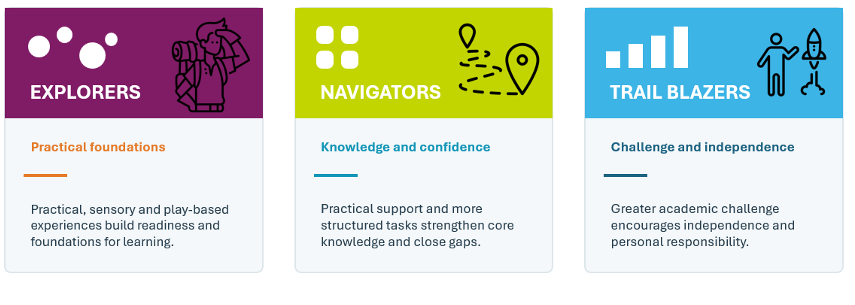
Our three academic strands describe how pupils access learning and the level of support and challenge they need. Each strand is closely linked to the pupil’s pathway. Both are reviewed regularly and can change as the pupil makes progress.
-
LTP Primary Curriculum
download_for_offline
download_for_offlineLTP Primary Curriculum
Pupil comes onto role and a thorough baseline process is vital to assess the pupils social and academic needs. Baselining is imperative to us due our short time with the pupil. Adding value to the baseline is is our focus and so this individual pupil plan forms the base of our curriculum offer for each pupil around their SEMH needs. Baselining involves discussion and data collection from the pupils school along with teacher assessment at ESA through knowledge and understanding of our practitioners.
The child is at the centre of the curriculum plan, and the whole offer is built around their SEMH need and the gradual build up of acceptance of demand.
Our curriculum is developmental not chronological: it is based on where a young person is in their development, not which year group they are in. Pupils will be assessed on entry in a range of ways, and their work will be tailored to their current stage of academic learning and SEMH development. For many of our pupils, their personal development and SEMH needs mean that work in this area has to be prioritised, as a vital first pillar in their learning journey. Therefore, we have ‘Nurture’ at the heart of everything we do. No learner is ready to develop academically if they do not have their basic needs met.
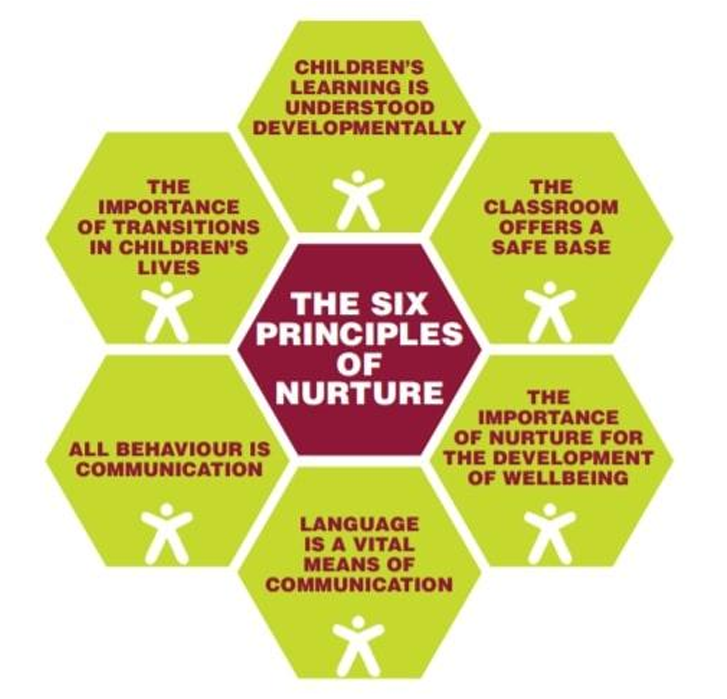
Following the Nurture principles and guidance, we are able to build feelings of safety, trust, choice, collaboration and empowerment in our pupils. The Nurture curriculum at follows research-based strategies in order to provide pupils with behaviour and connection support as well as re-engaging them with education.
The Primary provision is underpinned by the 6 core principles of Nurture, attachment theory and utilises a trauma-informed approach. As stated in Ofsted guidance, ‘Nurture groups are small, structured teaching groups for pupils showing signs of behavioural, social or emotional difficulties, particularly those who are experiencing disruption or distress outside of school. They aim to provide a predictable environment in which pupils can build trusting relationships with adults and gain the skills they need to learn in larger classes. There is an emphasis on the systematic teaching of behavioural and social skills, on learning through play, and on sharing ‘family-type’ experiences, such as eating food together.’ This approach enables us to develop secure relationships with our pupils in a calm and trauma-reduced environment where pupils are better able to focus on developing their social and emotional skills amongst staff that are specifically trained to support this.
The collective aim of our Nurture sessions is to enable pupils to make a successful transition back to mainstream education so that they can continue on a successful academic journey moving forward. There is much research to support that Nurture Groups are able to support pupils to make progress both socially and emotionally. As stated in Ofsted’s report into Nurture Groups ‘Supporting children with challenging behaviour through a Nurture Group approach’ “The most common aim for the Nurture Group provision was to give pupils the skills and strategies they needed to enable them to remain in mainstream education both in the short and long term. Nurture Groups aim to provide a safe, comfortable, home-like environment, with clear routines and adults modelling positive relationships, in line with Nurture Group principles.
Zones of Regulation- We use the zones of regulation to support pupils to learn about emotions and their own needs when they feel a certain way. Zones of regulation helps pupils to become independent regulators. Zone is used everyday in class so the pupils can do real learning around feelings that happen in real time.
Maths - White Rose Scheme of work is followed to ensure joined up learning experiences with main stream. White rose offers a cyclic, spiral curriculum and is favoured in most primary schools. We offer learning alongside this scheme at a level that the pupils are willing to engage in. Some over learning will happen initially to encourage the pupils “getting it right,”
English - is planned out over the year to ensure a full coverage of texts and writing style are covered to ensure out learners do not get out of touch with their main stream peers. We use a progression of skills document to track progress from EYFS-y6. This way we can clearly ensure progress occurs and recognize areas of difficulty and offer intervention around this. We use Read Write Inc and Early star reader to teach reading.
Science - Science is taught inline with the white rose science scheme. We offer the year 1, 3 and 5 years of progressive curriculum. After baselining the pupils and gaging their ability immerse them in scientific opportunities inside and outside the classroom. We differentiate to the exact ability of the pupils and have a clear focus on scientific enquiry to ensure the pupils have the disciplinary knowledge they need to continue to access and enjoy the subject once they transfer back to mainstream.
PSHE - Is broken down into 6 topics for the 6 half terms in the year. These topics cover a wide range of issues and content as suggested in a variety of PSHE primary schemes of work. Online safety, Growing up, moving on, acceptance and making friends are just some of the areas of learning that we offer. PSHE tends to be taught throughout all elements of the day and discretely through all other subjects. As staff know the pupils PSHE needs and focus on their development in line with real issues that occur throughout each working day. This makes learning meaningful for our pupils. Our PSHE objective can also be met though thrive lessons and our topic based afternoon sessions. Clear objective for PSHE are sited on the medium term plans. PSHE is also delivered reactively to handle any timely issues that occur in class.
We use a document that focusses on the subject specific skills and the ladder of skills primary pupils work on throughout their primary career. This document ensures pupils make progress in the foundation subjects inline with their individual needs and interests.


